
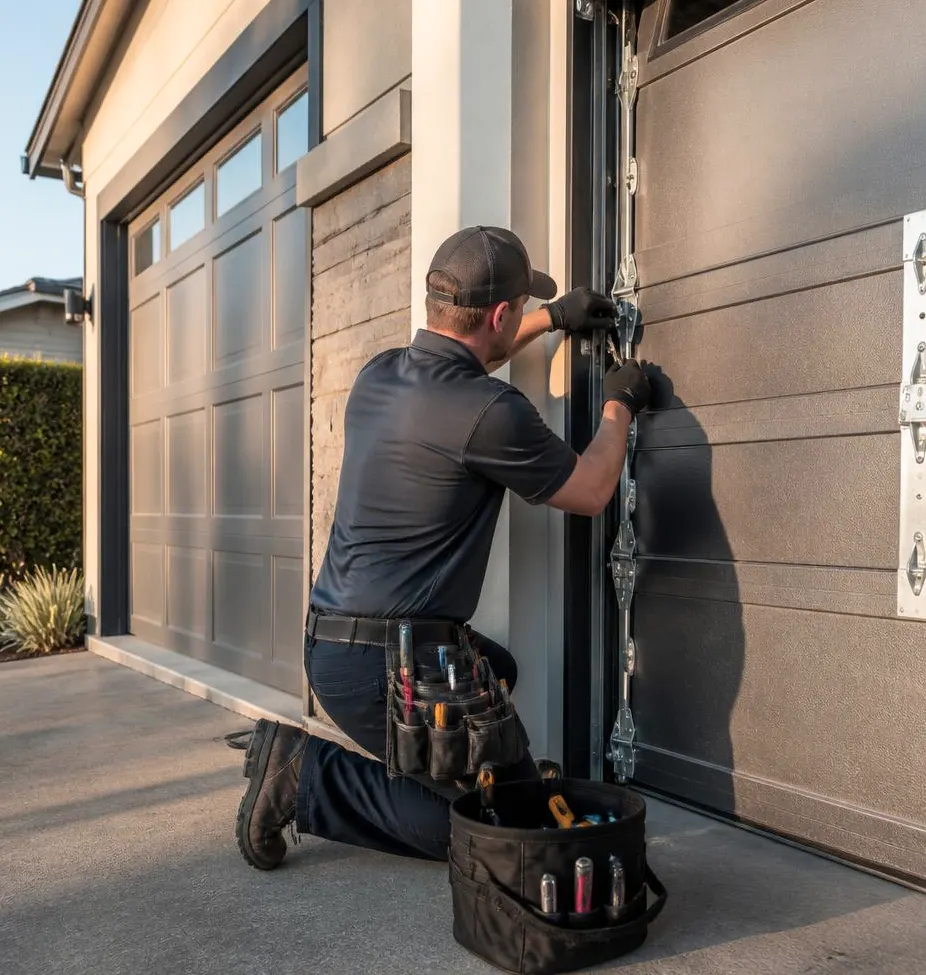
The Morning It Just Won't Go
You're backing out for work, it's barely above freezing, and you hit the remote. Nothing. No motor sound, no light, no movement. Or maybe the opener hums but the door doesn't budge. Or it lifts three inches and stops dead. Whatever the exact moment looks like, that split second of "why isn't this working" is familiar to almost every homeowner eventually — and the good news is that a technician doesn't guess. There's a specific order they check things in, because the most common causes are also the fastest to rule out.
What You're Seeing Narrows It Down Fast
Before any tools come out, the symptom itself points toward a category of problem:
- Total silence, no lights, nothing — almost always power related.
- Opener light blinks but door doesn't move — often a safety sensor issue.
- Motor runs but the door doesn't lift — points to the trolley, gear, or a broken spring.
- Door is heavy, won't open by hand either — spring or cable failure.
- Door opens partway then reverses or stops — sensor misalignment or a track obstruction.
Keeping that symptom in mind helps make sense of the checklist below.
The Order a Technician Actually Checks
1. Power to the Opener
This sounds basic, but it's first for a reason: it's the quickest fix and the most overlooked. A tripped breaker, a loose outlet connection, or even a unit that's simply been unplugged (sometimes by a vacuum cord or a seasonal decoration) will stop everything cold. A technician checks the outlet, the breaker panel, and the cord before touching anything mechanical.
2. Remote and Wall Control Batteries
Dead remote batteries are common enough that they're checked right after power. Cold weather drains batteries faster, so this becomes more frequent as Fort Wayne winters set in. If the wall-mounted control still works but the remote doesn't, this is almost always the answer.
3. Safety Sensor Alignment
Every opener built in the last few decades has two small sensors near the floor on each side of the track, aimed at each other. If they're knocked out of alignment, covered in condensation, or blocked by anything — a stray leaf, a box, even direct morning sun hitting the lens — the opener won't close the door and in some cases won't open it either, since the logic board reads it as an obstruction fault. A technician checks for a solid indicator light on each sensor and realigns or cleans them as needed. This is a frequent fall and winter call simply because humidity, frost, and blowing debris all interfere with the sensor beam.
4. The Manual Disconnect
Every opener has a red-handled rope that disengages the trolley from the chain or belt, usually for use during a power outage. If that cord gets bumped — by a stored bike, a ladder, a kid reaching for something — the opener runs but the door doesn't move at all. A technician checks the trolley position on the rail before assuming anything more serious is wrong.
5. Springs and Cables
If the door won't move by hand either, this is where attention shifts. Torsion springs mounted above the door, or extension springs along the upper tracks, counterbalance the door's full weight. When one breaks, the door becomes too heavy to lift — manually or by the opener — and may only move an inch or two before stalling. A visibly gapped spring, a loud bang heard earlier in the day, or a cable hanging loose at the bottom bracket all confirm this. Spring replacement is not a DIY repair; the springs are under high tension and professional tools are required to handle them safely.
6. Track and Rollers
Fort Wayne's winters bring road salt, slush, and ice that get tracked into garages and can corrode or freeze roller hardware. A visibly bent track, a roller that's popped out of the channel, or ice buildup at the base of the door can all stop smooth travel. A technician checks the track's alignment with a level and inspects rollers for wear or debris before moving on.
7. The Opener's Gear or Motor
If power is good, sensors are aligned, and the door is properly balanced but the opener still won't engage, the internal gear — often a nylon drive gear designed to be a sacrificial part — may have stripped. This produces a motor that runs but a carriage that doesn't move. Replacing the gear kit resolves it, though on older units a full opener replacement is often more practical.
8. The Logic Board
Last on the list because it's the least common cause: if everything mechanical checks out and the opener still won't respond correctly, the circuit board itself may have failed, sometimes due to a power surge. This usually requires board replacement or a new opener unit.
Why Fort Wayne's Seasons Make This Worse
Big temperature swings mean metal expands and contracts, hardware loosens over a season, and cold makes grease stiffen inside gear housings. Add salt and moisture tracked in from icy driveways, and it's easy to see why opener and track issues cluster heavily in late fall and winter here. A door that worked fine in October can develop a sensor or hardware issue once overnight temperatures start dropping consistently.
When to Call Fort Wayne Door & Opener
If you've checked power and batteries and the door still won't open, it's time to call. A broken spring, a stripped gear, or a misaligned track aren't safe or practical to handle without the right tools, and attempting it can turn a repair into a replacement. Fort Wayne Door & Opener handles garage door opener repair and installation as well as spring replacement, and we'll walk through the same checklist above on-site so you know exactly what's wrong before any work starts.
If your garage door in Fort Wayne, New Haven, Huntertown, or anywhere nearby won't open, give Fort Wayne Door & Opener a call — we'll get it diagnosed and working again.